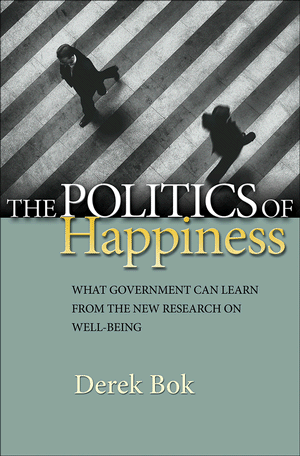
Special Guest! Derek Bok, author of "The Politics of Happiness"

Print


Did you know? The nation of Bhutan has made "Gross National Happiness" the central aim of its domestic policy!


Happiness has become a hot topic, and researchers world-wide are investigating the relationship between happiness and career, family life, religion, and a multitude of other lifestyle factors. As these findings rise to the surface of our collective consciousness, so does this question: How might happiness research affect government policy in the United States--and beyond?


In the book The Politics of Happiness, author Derek Bok examines how governments could use happiness research in a variety of policy areas to increase well-being and improve the quality of life for citizens. Recognizing both the strengths and weaknesses of happiness research, Bok looks at the policy implications for economic growth, equality, retirement, unemployment, health care, mental illness, family programs, education, and government quality, among other subjects.

On April 26th at 7 pm in PC East, you can hear what Derek Bok has to say in person!


Derek Bok is the 300th Anniversary Research Professor at Harvard University. From 1971 to 1991, he served as Harvard's twenty-fifth president, and served again as interim president from 2006 to 2007. He is also the author of The State of the Nation and The Trouble with Government, and coauthor of The Shape of the River (Princeton).

Wellness Journalism: Who Needs Trees?

Print


We walk past them all day long…but when is the last time you really stopped to appreciate a tree?

Trees are a basic, essential ingredient in the recipe we call life. They give shelter and shade. Many trees also provide food such as nuts and fruit, along with paper, medicines, and fuel. Not only that, but you can climb a tree (carefully) when you need a quiet, peaceful place to think, read, or relax.

Trees lower air temperature by evaporating water in their leaves, stabilize the soil, and prevent erosion. They improve water quality by slowing and filtering rain water as well as protecting aquifers and watersheds. In addition, they reduce noise pollution by acting as sound barriers.

Most importantly, however, trees serve as air-purifiers and oxygen-providers. A single tree produces nearly 260 pounds of oxygen each year! Trees clean the air by filtering out dust and pollutants—and with large amounts of carbon dioxide, methane, and other toxic gasses pouring into the atmosphere every day, trees are more important than ever in helping to keep this planet habitable for humans. In one year’s time, an acre of trees can absorb as much carbon as it produced by a car driven 8,700 miles (according to the International Society of Arboriculture).


Deforestation is the removal of a forest or stand of trees in order to use the land for something else—parking lots, agriculture, housing tracts, or mini-malls. This “urban sprawl” has cost us precious habitat and biodiversity, while increasing aridity and soil erosion. Unfortunately, every year, one million acres of forest are lost to city growth.

Wellness Journalism: Got Worms?

Print

Top-notch Top soil: Why Composting Works


One of our major environmental issues is that landfills everywhere are running out of room, and the EPA estimates that roughly 25% of the garbage in the U.S. is made up of yard trimmings and food scraps. That's over 60 million tons each year! This material does not break down when tossed in with the regular garbage. Instead of adding to the trash heap, try composting.

From apple cores to egg shells, composting is a great way to turn food waste into nutrient-rich soil. Organic compost loosens clay soils and retains water, suppresses plant disease and pests, and produces higher yields of healthier fruits, vegetables, and flowers.

Live in an apartment? Worm composting, also known as Vermiculture, is a fun and easy method for year-round food scrap handling. Worm compost is made in a container filled with moistened bedding (often shredded newspaper, leaves, and a handful of sand or soil) and red wrigglers (also known as branding or manure worms). Simply add your food waste into the bin and the worms will munch away—eventually converting the entire contents into rich compost!

If you plan to make a traditional compost pile outdoors, consider the following:


4 Tips for Making Better Compost


1. Get the Right Balance of Compost Materials Getting the right mixture of brown (carbon) materials to green (nitrogenous) materials is essential. Excess carbon will result in a pile that takes a long time to decompose, (a rhyme to help you remember: “too much brown, won’t break down”), while too much nitrogen will make it stink. To optimize your mound, keep a ratio of 30 parts carbon to 1 part nitrogen.

2. Turn the Compost Regularly Add fresh air to your mix by stirring the pile about every two weeks. The bacteria that are working to break down the compost need to breathe! This can be made simple with a compost tumbler.

3. Shred Material Shredding or chopping your compost, especially the dry carbon materials, will help speed things along. It increases the surface area that the compost microbes have to work on and provides a more even distribution of air and moisture.

4. Add a Secret Ingredient Toss in an activator such as alfalfa meal to provide much needed nitrogen and protein, and greatly expedite the compost process. You can find alfalfa meal in garden centers and online retailers. The results are remarkable! Other secret ingredients that help compost piles include fresh manure, bone meal, blood meal, comfrey, or even high-protein dry dog food.

Wellness Journalism: 8 Ways to Love the Environment While You're in College

Print

With Spring comes Environmental Wellness month! Things are off to a busy start this quarter, to be sure, and you might not think you have enough time to save the world. The good news? It doesn't take much effort to make an impact for the better!!!


8 (Easy) Ways to Love the Environment While You’re in College


1. Utilize sunlight. Study near a window or outside altogether. Not only does it save electricity, it’s better for your brain!


2. Take the bus or shuttle. Parking permits are expensive, and by the time you’ve circled the parking lot for 30 minutes, it isn’t worth it anyway. Then there’s the cost of gas…


3. Get involved. Explore sustainability courses, participate in research, or join a student organization. Visit sustain.ucsd to check out some options!


4. Bring Your Own Bottle—and bowl, and fork. You can cut waste by avoiding single-use, disposable containers and cutlery at mealtimes.


5. Conserve water. Take shorter showers, and use water sparingly when brushing teeth or washing dishes. And mind the adage: “If it’s yellow, let it mellow. If it’s brown, flush it down.”


6. Save paper. Print on both sides, and use scrap paper for note-taking. Inspire your professors and classmates to do likewise.


7. Eat local, organic food. Take advantage of the Farmer’s Market, Food Coop, and Farm To You programs. Don’t be fooled by the perceived convenience of Burger King--there is fast, fresh, healthy food to be found on campus.


8. Buy natural products. Most store-brand shampoos and soaps contain chemicals known to cause skin irritation and other health problems. Read ingredient labels: if there is something in there you can’t pronounce, don’t buy it.

Wellnes Journalism: Sweet Dreams

Print

I’m walking through campus and an older man in a green sweater approaches me. “I have your driver’s license,” he says. This makes sense, somehow, and I respond: “That’s fine. Just turn in it to the professor after class.” I give him a friendly smile but he now resembles my high school English teacher, Mrs. Phillips.

At this point, I realize I am dreaming.

When you become aware that you are dreaming while still in the dream, you’re having what is called a lucid dream. Beyond providing a fascinating out-of-body sensation, lucid dreams are a forum for experimentation, exploration, and empowerment. Let’s say you dream that a large, hairy monster is trying to pound down your front door. If you know that you’re dreaming, you have no reason to be afraid. You have options. You can whip up a quick explosive device, or excuse yourself through a back door, or talk it into becoming a cute little puppy.

The dream world is complex, to say the least. Through dreams you experience a great many feelings and scenarios, all real aspects of some element within the psyche.

A lucid dream can begin in one of two ways. A dream-initiated lucid dream starts as a normal dream before you catch on to the fact that you’re dreaming, while a wake-initiated lucid dream occurs when you slip from a normal waking state directly into a dream state.

Either way, you can test your environment to determine whether or not you are awake. The pinch test—"Pinch me, I think I'm dreaming!"—is not actually an effective indicator of reality; a dreamed pinch will probably feel just like a real one. However, there are some tell-tale signs that expose a dream for what it is:
• Look at text or a digital watch. Remember what it says, look away, and then look back. The information will likely have changed.
• Look into a mirror (if you dare). Reflections are often blurred or distorted.
• Look at the ground beneath your feet, or at your hands. What you see may be quite different from what you’re used to…

Intrigued? Start by writing down your dreams every morning when you wake up; this will strengthen your dream recollection. Keep your eyes closed while trying to remember the dream, and then record what you remember in the present tense. Over time you can consciously develop awareness within dreams.

Flying, time-travel, magical ability—all yours with the power of lucidity!

Wellness Journalism: In the Raw

Print

Does the idea of a raw food diet sound like a slow, boring death? It did to me at first. The thought of never eating a delicious hunk of honey-glazed salmon with grilled asparagus and sweet potato fries…alas. I couldn’t picture myself saying “Oh, no thank you. I’ll just eat this handful of nuts and this head of lettuce.” It’s like instant alienation; a brutal self-exile from Foodland.

But as it turns out, raw food eaters are much more resourceful—and creative—than I realized. From pizzas to pastas and desserts, there’s a wealth of incredible edibles available in the raw. For some examples, click here.

We do live in a culture of cooked food, where “slaving over the stove” is thought to produce a square meal. But with all the fancy frying, roasting, grilling and baking, we’ve forgotten the awesome power of food in its raw, natural state.

When it comes to sheer nutritional value, nothing compares to raw food. Raw food retains all of its life-giving properties, whereas cooking denatures the proteins and destroys many of the enzymes that benefit digestion. Processed food costs the body a great deal more energy to break down and scour for nutrients. So what does a body do with the extra energy? For one thing, it heals itself. A raw food diet has, in many cases, been known to stop or reverse the advance of many chronic diseases, including diabetes, heart disease, and cancer. It can relieve constipation, heartburn, gas, and other digestive malfunctions. The increased physical vitality also helps to protect against ordinary colds and flu.

While I have a new appreciation for the benefit and bounty of a raw food diet, I haven’t totally crossed over yet (there’s an omelet sitting next to me right at this moment). But I do make an effort to eat more food raw—and I have it in mind to gradually increase my raw food intake over the coming year. I notice that the more food I eat raw, the more satisfied I feel. It seems to harmonize with my body. And in fact, raw food has the best balance of water, nutrients, and fiber to meet the body’s needs. It’s like putting ultra-super-premium gasoline in your car.

A final thought: eating food raw also saves time and money. And consider: no burns to the hand or mouth, no kitchen fires, less preparation, and easier to clean up! Bon appétit.

For more information about raw food diets and health issues, check out the following studies:

Cardiovascular health: http://jn.nutrition.org/content/135/10/2372.abstract?maxtoshow=&HITS=10&hits=10&RESULTFORMAT=&fulltext=raw+food&searchid=1&FIRSTINDEX=0&sortspec=relevance&resourcetype=HWCIT

Breast cancer risk:http://www.informaworld.com/smpp/content~db=all?content=10.1207/S15327914NC4602_05

Diabetes (through the reduction of diet derived advanced glycation endproducts (AGEs) that are produced through heating food):http://www.ncbi.nlm.nih.gov/pmc/articles/PMC21074/?tool=pmcentrez